Train An Imaginative Agent

Jiaxin Ge1,* Junyi Zhang1,* Tianning Chai1,* Hanjun Yoo1 Chenyang Wang2 Xiuyu Li2 Weijia Shi3 XuDong Wang1,4 Sewon Min1 Luke Zettlemoyer3 Trevor Darrell1,† Haiwen Feng1,2,†

1University of California, Berkeley 2Impossible Research 3University of Washington 4Duke University

* Equal contribution† Equal advising

Agima (Agentic Imagination) trains an agent to imagine before it acts: a single omni model generates images of where its actions lead and plans over these imagined futures.

How Agima imagines

Agima generates actions and imagined frames in one sequence. Each imagined frame is the observation for the next action.

Figure 1. Planning with agentic imagination: (a) feedback after acting, (b) feedback through imagination with Agima, (c) counterfactual branching and forward thinking in Sokoban.

Linear rollout

ot â ô â ô … ô

Imagines the frame after each action and plans the next action from it.

Counterfactual branching

ot â′ ô′ ✗ reject â ô â ô …

Imagines an alternative action and rejects it when its outcome fails.

Forward thinking

ot AB â ô … ô ✗ fails â ô … ô ✓ commit

Imagines complete candidate plans and commits to the one that succeeds.

Figure 2. The three ways Agima plans with imagined frames. Select one to mark it in Figure 1. Real frames are solid and imagined frames dashed blue. Green marks the plan that works and red a dead end.

Environments

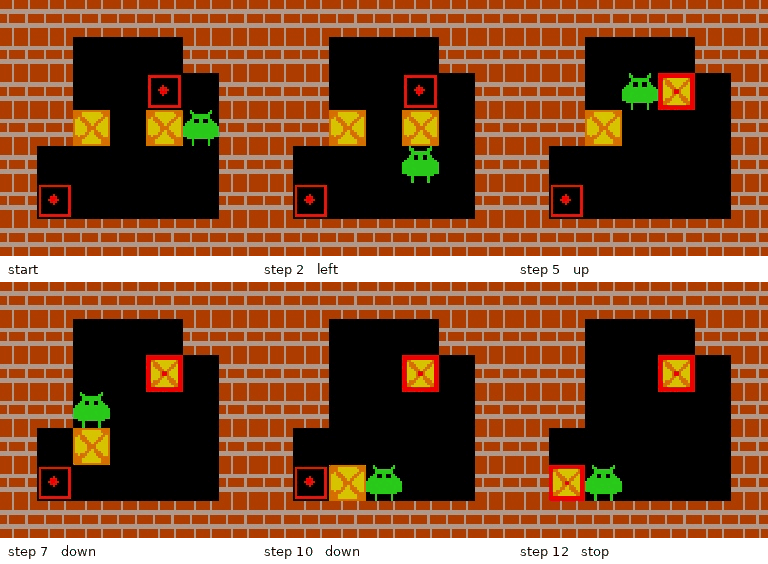
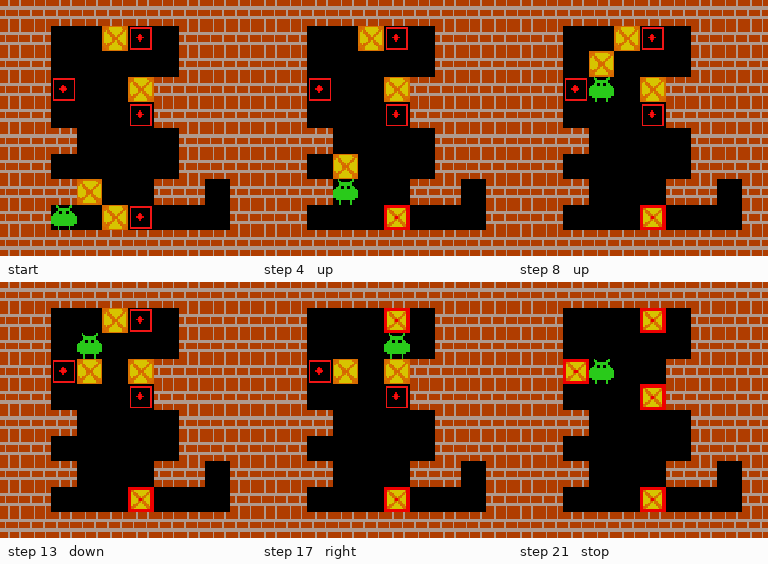
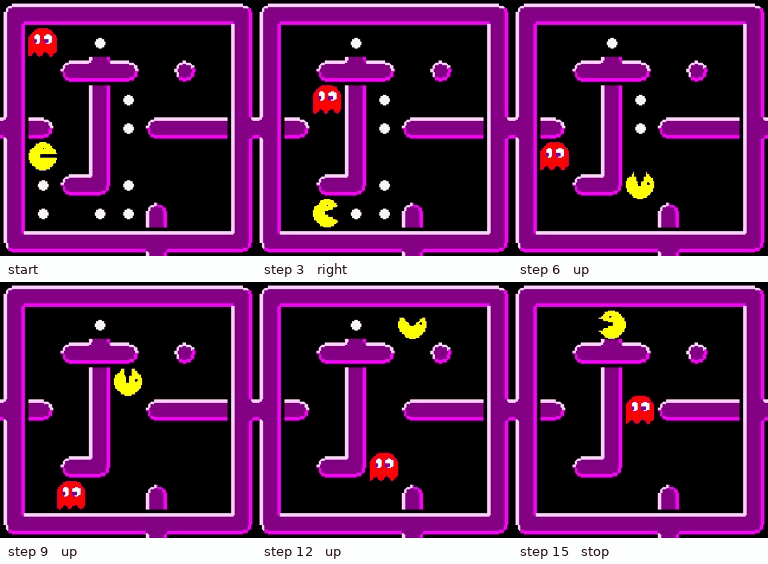
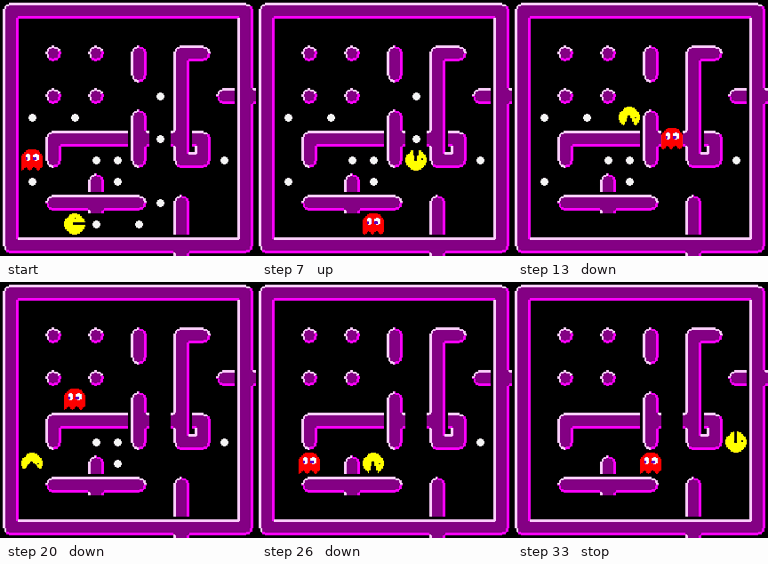
We train Agima on the easy split of four environments and test it on a harder split it never sees in training.
Maze2D

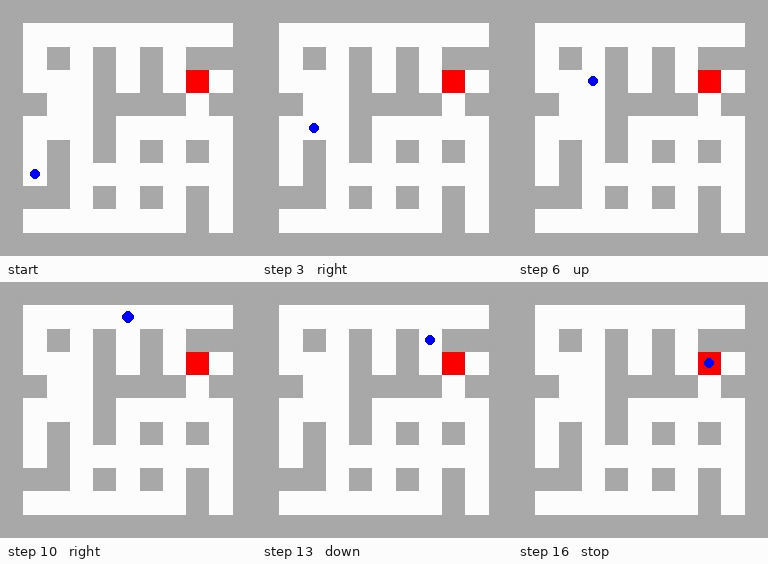
Maze2D training episode, ground-truth rollout.
11×11 maze
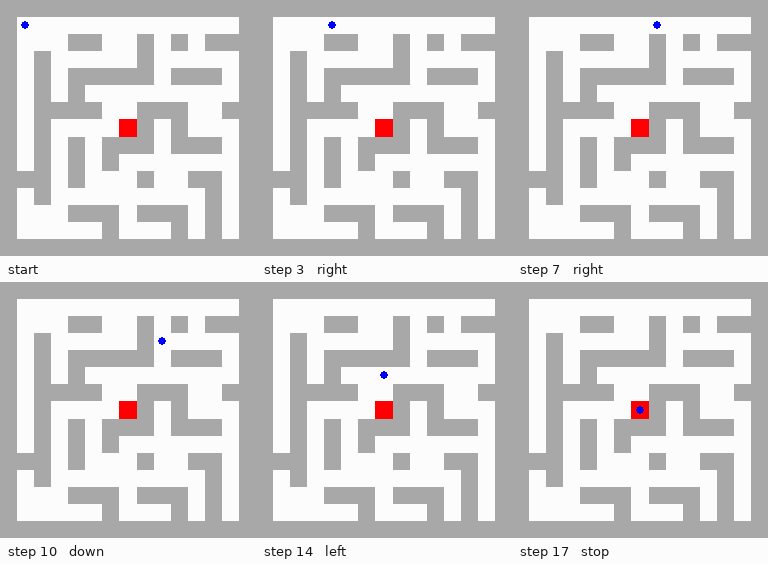
Maze2D test episode, ground-truth rollout.
Larger maze

Sokoban

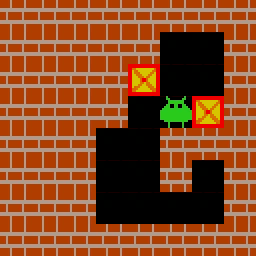
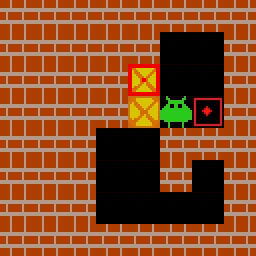
Sokoban training episode, ground-truth rollout.
Two boxes
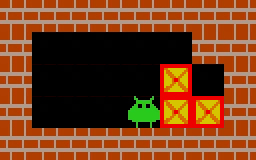
Sokoban test episode, ground-truth rollout.
Four boxes

Pacman

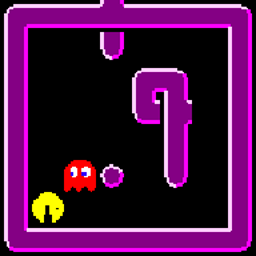
Pacman training episode, ground-truth rollout.
9×9, 8 food
Pacman test episode, ground-truth rollout.
12×12, 12 food, closer ghost

PushT

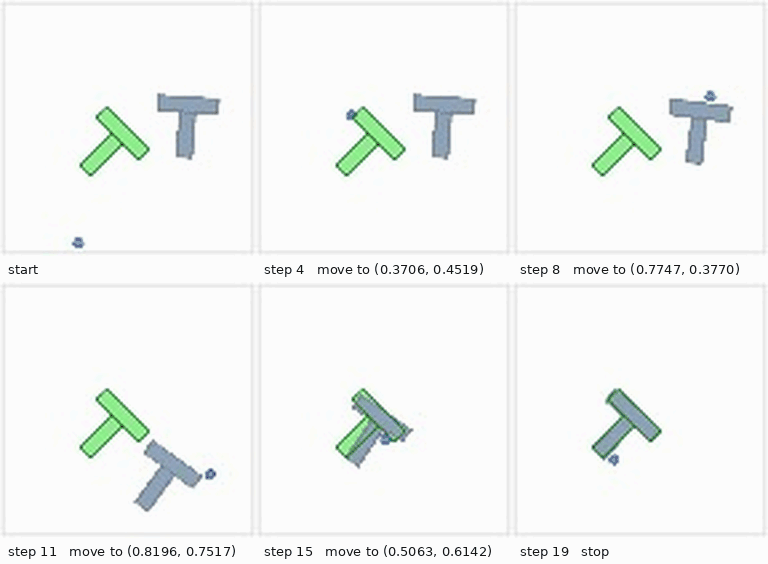
PushT training episode, ground-truth rollout.
Starts near the center
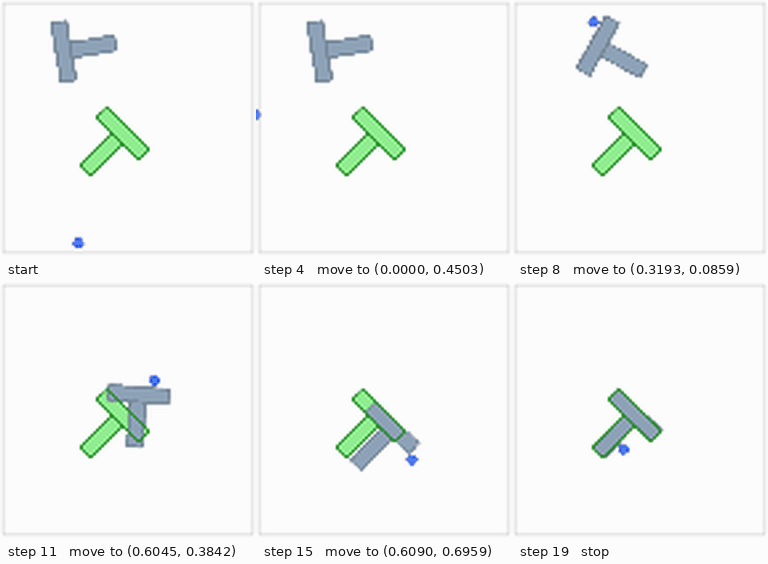
PushT test episode, ground-truth rollout.
Starts far from the center

Figure 3. Ground-truth rollouts: the training split on the left of each pair, the test split on the right.

Easy-to-hard generalization

K is the number of actions Agima executes per real observation. Between observations, it plans from its own imagined frames.

Planning traps

Test sets where a locally reasonable move fails several steps later. K = ∞.

Deadlock

One push puts the nearer box on the goal beside it. That goal is the only one the farther box can ever reach, so the farther box is left with nowhere to go.

A 2-box level from Agima's Sokoban generator. Test sets: 2, 3 and 4 boxes, 100 puzzles each.
Nearer box first
Nearer box first: one push puts it on the goal below it, in the corridor; the farther box, pushed toward the other goal, is stopped by it.

Farther box blocked

Farther box first
Farther box first: it is pushed along the corridor to the far goal, then the nearer box onto its goal. Solved in 18 moves.

Solved in 18 moves

Figure 5a. Two runs from the same start on a Deadlock level: nearer box first (left) and farther box first (right).

Irreversible push (Structural Fork set)

Two pushes are legal here. Pushing up pins a box to the wall in a row with no goal, and no later move brings it back. Pushing right keeps the puzzle solvable.

Test sets: 2, 3 and 4 boxes, 100 puzzles each.
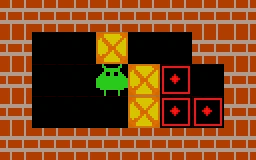
Push up
Push up: the box is pinned to the top wall, in a row with no goal; nothing can push it back down.

Box pinned to the wall

Push right
Push right: the puzzle stays solvable; all three boxes reach their goals in 13 moves.

Solved in 13 moves

Figure 5b. Two runs from the same start on a Structural Fork level: pushing up (left) and pushing right (right).

Pacman route order

Going for the nearer food first leaves Pacman no escape from the ghost. Going for the farther food first clears the level.

The episode from Figure 3 of the paper. Test grids are 8×8 with 2, 4, 6 or 8 food, and 10×10 with 8.
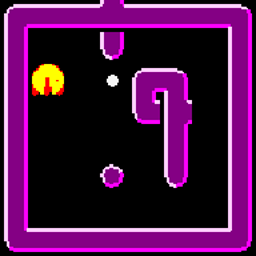
Nearer food first Agima-A7B
Nearer food first: Pacman eats the food to its left, heads up for the other one and is caught by the ghost.

Caught by the ghost

Farther food first Agima-A7B (Forward)
Farther food first: Pacman eats the upper food, comes back down for the food on the left and clears the level.

All food eaten

Figure 5c. Agima-A7B and Agima-A7B (Forward) on the same Pacman episode.

Learning when and where to imagine

We run RL from the SFT models on three-box Sokoban, with a binary success reward and nothing else.

RL improves held-out planning

Every imagination variant improves, including on four-box puzzles it never sees in RL, while the action-only model stays near zero.

Figure 6. Held-out accuracy over 200 RL steps: (a) Agima-A7B (Forward) on the Deadlock set and (b) Agima-A7B (Branching) on the Fork set, each with Agima-A7B and No Imagine for reference. Solid lines are 3 boxes, dashed lines 4 boxes (paper Fig. 4b–c).

A new unified format emerges

After RL, Agima rolls out one plan step by step and drafts the next only once it foresees a failure. Second plans drop from 79% to 26–31% of episodes.

Paper Figure 5, the same Sokoban puzzle before and after RL. (a) Before RL: Format 1 imagines one plan step by step; Format 2 imagines Candidate 1, which succeeds, and Candidate 2, which reaches deadlock, and commits to Candidate 1. (b) After RL, the unified format: a step-by-step rollout reaches deadlock, Candidate 2 reaches deadlock, Candidate 3 succeeds and is committed. (opens the full-size image)
Figure 7. The same Sokoban puzzle before and after RL (paper Fig. 5).
Figure 8. Agima-A7B (Forward) on the Deadlock set over RL steps: (a) episodes whose first plan is predicted to fail, among those with a second plan, and (b) episodes in the unified format (paper Fig. 6a–b).

Branching moves to critical decisions

After RL, Agima branches more often, and more of its branches land where one push would make the puzzle unsolvable.

Figure 9. Agima-A7B (Branching) on the Fork set over RL steps: (a) mean branches per episode and (b) the share of branches placed at a critical step (paper Fig. 6c–d).
Figure 10. An illustration, not a recorded episode. Both models branch, but after RL more branches land on critical steps like this fork (63% to 73%, 3 boxes).

Citation

@misc{ge2026trainimaginativeagent,
  title         = {Train An Imaginative Agent},
  author        = {Ge, Jiaxin and Zhang, Junyi and Chai, Tianning and Yoo, Hanjun and Wang, Chenyang and Li, Xiuyu and Shi, Weijia and Wang, XuDong and Min, Sewon and Zettlemoyer, Luke and Darrell, Trevor and Feng, Haiwen},
  year          = {2026},
  eprint        = {2610.26845},
  archivePrefix = {arXiv},
  primaryClass  = {cs.AI},
  url           = {https://arxiv.org/abs/2610.26845}
}